Frequently Asked Questions
What you need to know about Colo-Check
On this page, you can find the most frequently asked questions about the purpose of the test, accuracy rate, sample types, application process, and clinical referral approach.
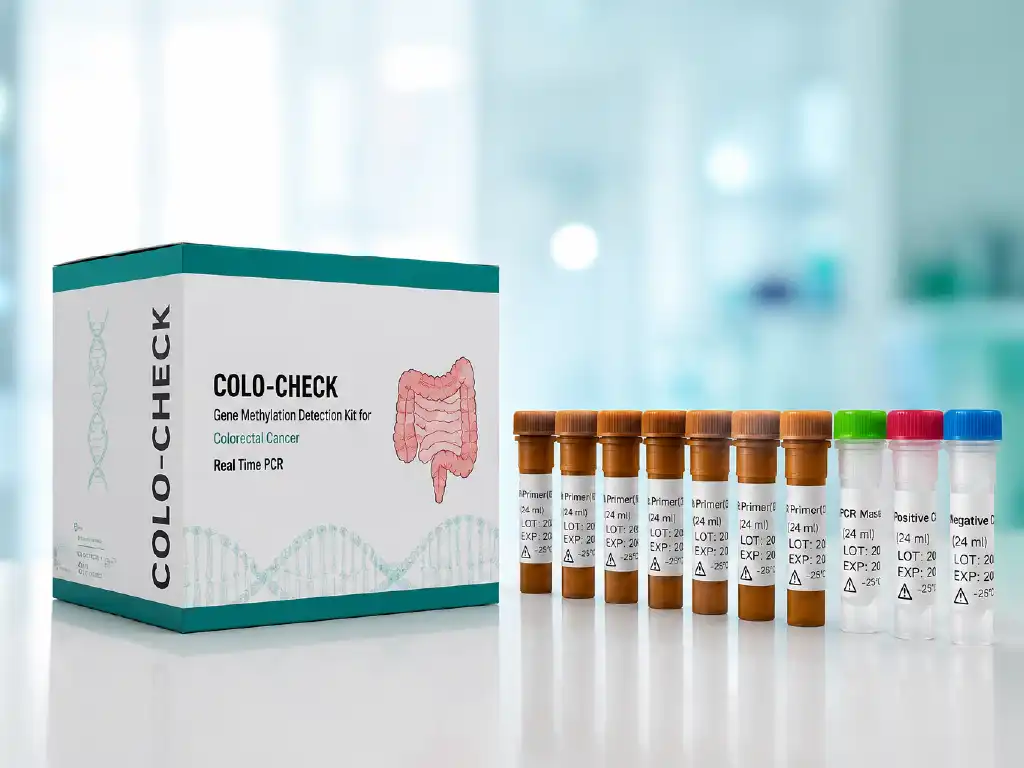
Colo-Check supports a modern molecular analysis approach in colorectal cancer screening.
Is Colo-Check an alternative to colonoscopy?
No. Colonoscopy is the gold standard diagnostic tool in clinical practice. In patients who test positive with Colo-Check, the presence of cancer must be confirmed by colonoscopy.
What is the accuracy rate of Colo-Check?
According to clinical cohort studies, the dual-matrix panel, in which stool and serum samples are analyzed together, has reached 90.6% sensitivity and 95.0% specificity values.
Can it detect cancer at an early stage?
Yes. One of Colo-Check’s strengths is its early-stage performance. The test offers high detection power by demonstrating approximately 90% sensitivity and 90% specificity even in Stage I and II tumors.
Is colonoscopy preparation required for the test?
No. Colo-Check is a non-invasive test. It does not require mandatory bowel preparation, challenging dietary restrictions, or sedation. Samples can be collected through a more comfortable process for the patient.
How is it different from the FIT/FOBT test?
Traditional FIT tests detect hidden blood in stool. Colo-Check, on the other hand, aims to track not only signs of bleeding but also cancer-specific molecular traces by targeting epigenetic changes.
Which samples are required for the test?
For the highest accuracy rate, simultaneous analysis of both stool and serum samples collected from the same patient is recommended. The system also has flexible panels that can work with stool-only or serum-only samples.
Who should take this test?
Colo-Check may be considered for screening purposes, especially for individuals over the age of 50 and high-risk individuals with a family history of colorectal cancer. A physician’s opinion should be obtained for personal risk status.
What are the shelf life and storage conditions of the kit?
The shelf life of the kit is 12 months from the date of manufacture. To maintain the stability and performance of the kit components, it must be stored in a deep freezer between -25°C and -15°C.
Highlighted topics
Three key points to understand Colo-Check
The following key points stand out in order to understand the position, purpose of use, and clinical referral approach of the test.
Screening support
Colo-Check supports a molecular screening approach for early diagnosis.
Clinical confirmation
Positive results must be confirmed through colonoscopy and specialist physician evaluation.
Patient compliance
The non-invasive application approach aims to support participation in the screening process.
Do you have a question?
Get more information about Colo-Check
You can contact us for detailed information about the test process, sample types, clinical performance, or conditions of use.